
Navigation / Home / Family History / DNA Project / Photos / Stories / Gravestones / Back to Generation 2
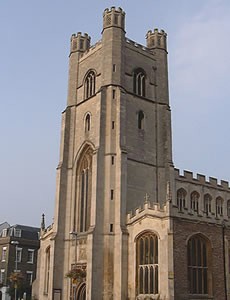
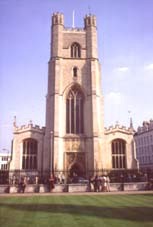
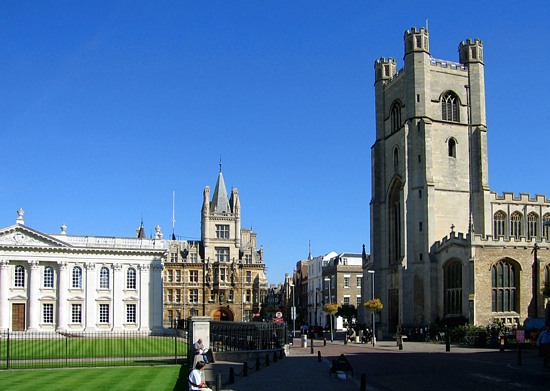
Great St. Mary's Church, Cambridge, England
The earliest record of a church on this site is from 1205, in the reign of King John, and this record shows that the church was already well-established by that date. In 1290 much of the building was destroyed by fire, and was rebuilt slowly after that.
Being the most substantial building in any community, churches were used for public functions in the Middle Ages, and as Cambridge University grew, it naturally sought to use the town's largest church for its official meetings and disputations (debates). It was also used for annual ceremonies such as the conferment of degrees, until the Senate House (just across the road, to the west of the church) was built in 1730.
In the mid-fifteenth century the University decided that the church building was too small for its purposes, and helped in the raising of funds for rebuilding. The building work started in 1478, and was completed in 1519, except for the tower, which was started at 6:45 p.m. on 16th May, 1478, and completed in 1608.
The leaders of the English Reformation preached in this church -- Erasmus, Cranmer, Latimer and Ridley. Martin Bucer, who influenced Cranmer when he composed the Book of Common Prayer, was buried here. When Mary came to the throne, she placed the church under an interdict and ordered Bucer's corpse to be burnt in the market place. Under Queen Elizabeth I, the dust where Bucer was burnt was brought to the church and placed beneath the brass inscription on the south side of the High Altar.
When Oliver Cromwell became "Protector", he suppressed the English Church. At his command the Book of Common Prayer was destroyed in the chancel.
The University Sermon was for many years a popular occasion both with students (who were fined for non-attendance) and with other local residents, and in 1735 the University added the galleries which greatly increase the seating capacity. University Sermons are still preached on some Sundays during University Full Term, at the time otherwise taken by Matins. There are also occasional series of talks on Sunday evenings, at the time previously used for the University Sermon for many years.
The 19th century saw great changes in religious thought and practice in Britain, with revival movements in several areas of the church. The Tractarian movement in particular emphasized reverence and sacramental worship, and this led to the removal of the east and west galleries (leaving the present north and south ones which are there to this day) and thus opening up the chancel to a clearer view from the nave.
John Botwright and Elizabeth Cropley were married in Great St. Mary's Church on Sunday (based on the old Julian calendar), December 30th, 1632. John and Elizabeth had their first three children, Elizabeth (1634), John (1635) and Lettice (1637) baptised at the church. The baptismal font was installed at the church the year they were married, so you are looking (below) at the actual font used for the baptism of their first three children.

From a sign on the font: "The font position near the door is significant as baptism is the entry into Christian life as a member of the church. In the public ceremony of baptism (christening) water from the font is poured over the head of the new Christian. The stone font was made in 1632 by George Thompson and the wooden cover was added in the 19th century."
During our visit, Great St. Mary's Church was in the middle of an extensive renovation, so most of the inside portion of the church was unavailable for touring/photos including the alter area where John and Elizabeth would have stood during their marriage ceremony.


View from the top of Great St. Mary's Church tower looking south - St. Edward's Church (where John and Elizabeth began to attend in the second half of 1639 and Elizabeth is buried) is in the center left of the photo:

View from the top of Great St. Mary's Church tower looking north:

View from the top of Great St. Mary's Church tower looking west - Kings College:

Map of the Cambridge city center, including Corpus Christi College in the fore ground and the Great St. Mary's Church in the center:

Great St. Mary's Church:

Great St. Mary's Church:


last modified: September 9, 2013
URL: http://www.boatwrightgenealogy.com
Navigation / Home / Family History / DNA Project / Photos / Stories / Gravestones / Back to Generation 2